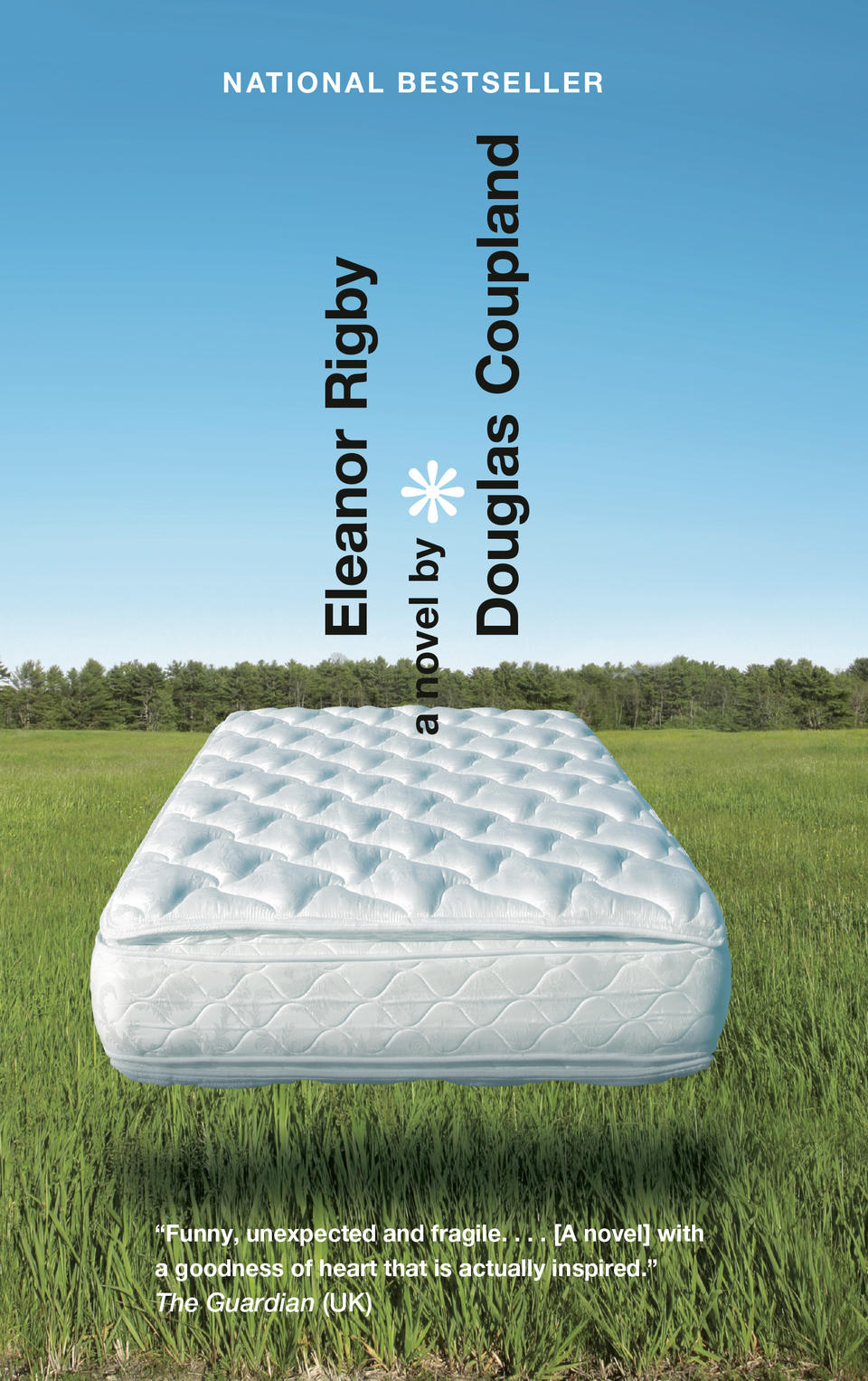
Eleanor Rigby
- Publisher
- Random House of Canada
- Initial publish date
- Oct 2005
- Category
- Psychological, Literary, Family Life
-
Paperback / softback
- ISBN
- 9780679313380
- Publish Date
- Oct 2005
- List Price
- $21.00
Add it to your shelf
Where to buy it
Description
Liz Dunn is one of the world’s lonely people. She’s in her late thirties and has a boring cubicle job at a communications company, doing work that is only slightly more bearable than the time she spends alone in her depressingly sterile box of a condo. Her whole life, she’s tried to get to the root of her sadness, to figure out what she’s been doing wrong, with little success. But then, one night in 1997, everything changes: while standing in the parking lot of a video store, arms full of sappy movies she’s rented to help her convalesce from oral surgery, she witnesses the passing of the Hale-Bopp comet. For Liz, this streak of light across the sky is a portent of radical change—and for her, radical change means finally accepting her lot: “I realized that my life, while technically adequate, had become all it was ever going to be . . . No more trying to control everything—it was now time to go with the flow.” In that moment, and for the first time, Liz feels truly free.
A day after Liz makes the decision to seek peace in her life rather than control, along comes another comet, in the form of a stranger admitted to the local hospital with her name and number inscribed on his MedicAlert bracelet. The young man, it turns out, is her son, whom she gave up for adoption when she was sixteen. Jeremy shows the scars of his years as a foster child and his most recent drug reaction, but is otherwise beautiful and charming. And when he moves in with Liz to recuperate, it’s as if both of them had been waiting for this moment all their lives.
With Eleanor Rigby, Douglas Coupland has given us a powerful and entertaining portrait of a woman who could be any one of us—someone who thinks it is too late to make anything of her life, who feels defeated by the monotony of her days, yet who also holds within her the potential for monumental change and for great love.
About the author
"
Douglas Coupland was born on a Canadian NATO base in Germany and raised in Vancouver, where he still resides. Among his best-selling novels are Generation X, Shampoo Planet, Polaroids From The Dead, Microserfs, Miss Wyoming, Hey Nostradamus! and Eleanor Rigby, altogether in print in some 40 countries. Coupland also exhibits his sculpture in galleries around the world, indulging in design experiments that include everything from launching collections of furniture to futurological consulting for Stephen Spielberg.
"
Excerpt: Eleanor Rigby (by (author) Douglas Coupland)
I had always thought that a person born blind and given sight later on in life through the miracles of modern medicine would feel reborn. Just imagine looking at our world with brand new eyes, everything fresh, covered with dew and charged with beauty — pale skin and yellow daffodils, boiled lobsters and a full moon. And yet I’ve read books that tell me this isn’t the way newly created vision plays out in real life. Gifted with sight, previously blind patients become frightened and confused. They can’t make sense of shape or colour or depth. Everything shocks, and nothing brings solace. My brother, William, says, “Well think about it, Liz — kids lie in their cribs for nearly a year watching hand puppets and colourful toys come and go. They’re dumb as planks, and it takes them a long time to even twig to the notion of where they end and the world begins. Why should it be any different just because you’re older and technically wiser?”
In the end, those gifted with new eyesight tend to retreat into their own worlds. Some beg to be made blind again, yet when they consider it further, they hesitate, and realize they’re unable to surrender their sight. Bad visions are better than no visions.
Here’s something else I think about: in the movies, the way criminals are ready to squeal so long as they’re entered into a witness relocation program. They’re given a brand new name, passport and home, but they’ll never be able to contact anybody from their old life again; they have to choose between death and becoming someone entirely new. But you know what I think? I think the FBI simply shoots everybody who enters the program. The fact that nobody ever hears from these dead participants perversely convinces outsiders that the program really works. Let’s face it: they go to the same magic place in the country where people take their unwanted pets.
Listen to me go on like this. My sister, Leslie, says I’m morbid, but I don’t agree. I think I’m reasonable, just trying to be honest with myself about the ways of the world. Or come up with new ways of seeing them. I once read that for every person currently alive on earth, there are nineteen dead people who have lived before us. That’s not that much really. Our existence as a species on earth has been so short. We forget that.
I sometimes wonder how big a clump you could make if you were to take all creatures that have ever lived — not just people, but giraffes, plankton, amoebas, ferns and dinosaurs — and smush them all together in a big ball, a planet. The gravitational mass of this new clump would make it implode into a tiny ball as hot as the sun’s surface. Steam would sizzle out into space. But just maybe the iron in the blood of all of these creatures would be too heavy to leap out into space, and maybe a small and angry little planet with a molten iron core would form. And just maybe, on that new planet, life would start all over again.
I mention all of this because of the comet that passed earth seven years ago, back in 1997 — Hale-Bopp, a chunk of some other demolished planet hurtling about the universe. I first saw it just past sunset while standing in the parking lot of Rogers Video. Teenage cliques dressed like hooligans and sluts were pointing up, at this small dab of slightly melted butter in the blue-black heavens above Hollyburn Mountain. Sure, I think the zodiac is pure hooey, but when an entirely new object appears in the sky, it opens some kind of window to your soul and to your sense of destiny. No matter how rational you try to be, it’s hard to escape the feeling that such a celestial event portends some kind of radical change.
Funny that it took a comet to trigger a small but radical change in my life. In the years until then, I’d been sieving the contents of my days with ever finer mesh, trying to sort out those sharp and nasty bits that were causing me grief: bad ideas, pointless habits, robotic thinking. Like anybody, I wanted to find out if my life was ever going to make sense, or maybe even feel like a story. In the wake of Hale-Bopp, I realized that my life, while technically adequate, had become all it was ever going to be. If I could just keep things going on their current even keel for a few more decades, the coroner could dump me into a peat bog without my ever having once gone fully crazy.
I made the radical change standing in the video store’s parking lot, holding copies of On the Beach, Bambi, Terms of Endearment, How Green Was My Valley and The Garden of the Finzi-Continis, staring up at the comet. I decided that instead of demanding certainty from life, I now wanted peace. No more trying to control everything — it was now time to go with the flow. With that one decision, the chain-mail shroud I’d been wearing my entire life fell from my body and I was light as a gull. I’d freed myself.
* * *
Of course, we’re born alone, and when we die, we join every living thing that’s ever existed—and ever will. When I’m dead I won’t be lonely any more — I’ll be joining a big party. Sometimes at the office, when the phones aren’t ringing, and when I’ve completed my daily paperwork, and when The Dwarf To Whom I Report is still out for lunch, I sit in my chest-high sage green cubicle and take comfort in knowing that since I don’t remember where I was before I was born, why should I be worried about where I go after I die?
In any event, were you to enter the cubicle farm that is Landover Communication Systems, you probably wouldn’t notice me, daydreaming or otherwise. I long ago learned to render myself invisible. I pull myself into myself, and my eyes become stale and dull. One of my favourite things on TV is when an actor is in a casket pretending to be dead, or, even more challenging, laid out on a morgue’s steel draining pan bathed in clinical white light. Did I see an eyelash flicker? Did that cheek muscle just twitch? Is the thorax pumping slightly? Is this particular fascination of mine goofy, or is it sick?
I’m alone now, and I was alone when I saw my first comet that night in the parking lot, the comet that lightened my burden in life. It made me so giddy, I chucked the rented tapes into my Honda’s back seat and went for a walk over to Ambleside Beach. For once I didn’t look wistfully at all the couples and parents and families headed back to their cars, or at the teenagers arriving to drink and drug and screw all night in between the logs on the sand.
A comet!
The sky!
Me!
The moon was full and glamorous — so bright it made me want to do a crossword puzzle under its light, just to see if I could. I took off my runners and, with them in hand, I walked into the seafoam and looked west, out at Vancouver Island and the Pacific. I remembered an old Road Runner versus Coyote cartoon — one in which the Coyote buys the world’s most powerful magnet. When he turns it on, hundreds of astonishing things come flying across the desert toward him: tin cans, keys, grand pianos, money and weapons. I felt like I’d just activated a similar sort of magnet, and I needed to wait and see what came flying across the oceans and deserts to meet me.
Editorial Reviews
"This book is funny and strange, but it's also moving and bittersweet . . . the story's ending proves unexpected yet exactly what you'd hoped: 'Even the most random threads of life always knit together in the end,' Coupland writes, and indeed they do. Eleanor Rigby is the most impressive novel he has written in years. It might prove to be among the best fiction of this new year as well." —Los Angeles Times
“Coupland’s . . . most accomplished work to date . . . could be one of the first great novels of the new century.” —Kirkus Reviews (starred review)
"Coupland's ear for the vernacular is solid, and his prose is lean and stripped, making for a fast read. . . . Coupland moves his story quickly, handling narrative flashbacks with assurance, and gives his plot several screwball twists." —San Francisco Chronicle
"Essentially the story of how a middle-aged spinster finally comes of age, throws off her isolation, and begins living her life, it is told with abundant wit and a deceptive simplicity, courtesy of a sardonic office drone named not Eleanor Rigby (the title is borrowed from a Beatles song about loneliness) but Liz Dunn. . . . Eleanor Rigby is earnest and warm-hearted, a pleasant landscape dotted with small deposits of profundity. Even as her struggles grow from small and solitary to almost absurdly oversize, Liz's voice remains wonderfully, wittily human." —Boston Globe
"Part of the joy in reading a Coupland book is the wonderful and unexpected way in which the details are meted out and skillfully woven together for the finale. All the same lively wit that was apparent in All Families Are Psychotic and Hey Nostradamus! is evident here, and Coupland’s talent for capturing the mundane and sparking recognition among his readers—especially Canucks—is here too." —The Guelph Mercury, Waterloo Region Record, Brantford Expositor
"Intricate plot twists aren’t the driving force of a Coupland novel. The true force is embodied here by the most weak-bodied of the book’s characters. Jeremy, through his drug-fuelled visions, offers original ideas about the Earth and how we’re looking after it. . . . [Coupland’s characters] all still struggl[e] with the big themes of life on Earth; love, loneliness, death and how to make sense of the world." —Victoria Times Colonist
"What makes [Coupland] hit us again and again, as though he were pelting meteorites from on high, is his ability to connect with ordinary human emotions and to make them profound." —ELLE Canada
"Coupland has a canny take on everything, and his oneliners zing because they invoke people you know . . . you’ll be right there with Liz as she discovers that, with a little push, any of us can find our proper place in the solar system." —People
"There’s a brief moment in [Eleanor Rigby] when he draws the reader’s attention to some peonies, cool and white and beautiful, placed in a room. They’re a fitting flower for a Coupland novel; his latest could rest next to the vase, equally cool and well-arranged." —Quill & Quire
User Reviews
Coupland has the best characters
One of my favorite things about Coupland are his quirky, down to earth characters and his descriptions of Vancouver and he has created one of my favorite characters in this book. Rigby is spacey and plain and it just makes her the most loveable. Love the simple development of the mother-son relationship with no disappointing twists.Other titles by

Binge
60 stories to make your brain feel different

Bit Rot

Boomerville
Musings on a Generation that Refuses to Go Quietly

Vancouver in the Seventies
Photos from a Decade that Changed the City

Paddle Against the Flow
Lessons on Life from Doers, Creators, and Culture-Shakers

Kitten Clone
Inside Alcatel-Lucent

Worst. Person. Ever.

Shopping in Jail
Ideas, Essays, and Stories for the Increasingly Real Twenty-First Century

Extraordinary Canadians: Marshall McLuhan

Fred Herzog: Photographs
Photographs

