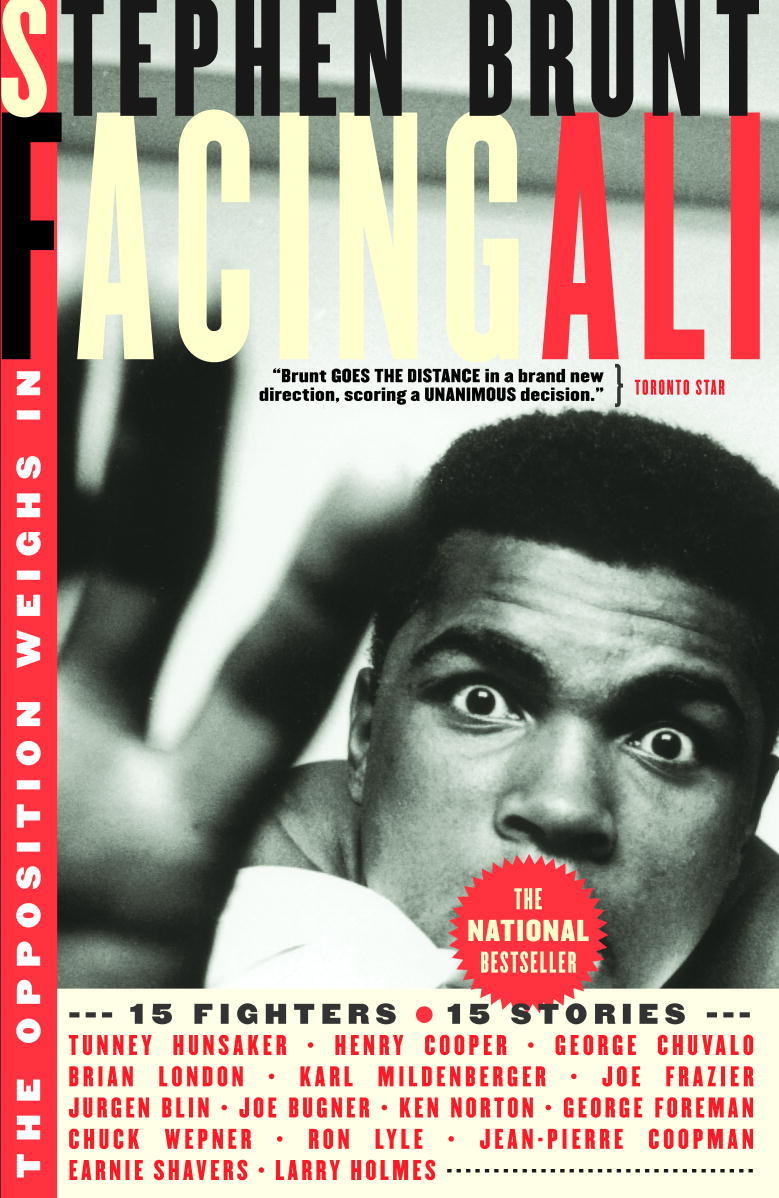
Facing Ali
15 Fighters, 15 Stories
- Publisher
- Knopf Canada
- Initial publish date
- Oct 2003
- Category
- Boxing, Sports, Sociology of Sports
-
Paperback / softback
- ISBN
- 9780676973518
- Publish Date
- Oct 2003
- List Price
- $22.00
Add it to your shelf
Where to buy it
Description
They won, they lost, they were scorned or cheered, but they got in the ring with the champ, and every fighter who got into the ring with Muhammad Ali shone brighter as a result. No life or career could be the same afterwards. Facing Ali is the an engaging portrait of this boxing phenomenon as told by 15 of his opponents—an incredible cross-section that reveals Ali as never before.
About the author
Contributor Notes
Stephen Brunt is one of Canada’s premier sportswriters and commentators. He lives in Hamilton, Ontario, and in Winterhouse Brook, Newfoundland.
Excerpt: Facing Ali: 15 Fighters, 15 Stories (by (author) Stephen Brunt)
SECONDS OUT: INTRODUCTION
Several years back, a former champion of the world began his comeback in humble surroundings. He certainly wasn’t a great fighter -- more a creation of promotional and managerial smarts than anything else -- but still, he’d known better places than Lulu’s, once, in an earlier life, a discount department store. Now it was billed as the world’s biggest nightclub, an enormous place containing several different bars and featuring musical acts from the fringes of the nostalgic imagination. The mystery of whatever happened to so-and-so, a one-hit wonder from the mid-1960s, was often solved when his name appeared on the marquee.
But staging a fight at Lulu’s was more of a risk than bringing in Mitch Ryder or Gary Lewis and the Playboys, and so even with a big name on the bill, the crowd was limited to a few hundred zealots, huddled together in one corner of the vast floor space. Those who were hip to the ways of boxing understood that a classic probably wasn’t in the cards. Though the glamour boy’s name was still worth money in the pugilistic economy, he needed a confidence builder. So his opponent would be chosen purely for his unthreatening nature, a career loser, a tomato can, an afterthought. His list of credits mattered not at all, since his role was entirely supporting. He would show up, act like a boxer, ideally put up a bit of a struggle and then be knocked out and forgotten -- on his way out of town before the star had even begun discussing his bright future with the attending sportswriters.
The opponent came from one of those places that seem to spawn them -- West Virginia, or Ohio, or Kentucky -- and he played his role to perfection. The ex-champion looked terrific, landing all his punches at will, while the man standing opposite him would get credit for bravery, and perhaps for masochism, until finally he surrendered. Then, just as the boys in the ringside-press section were wrapping up that neat, familiar little story, the man who had been working the opponent’s corner, a friend from way back where, walked out and confronted them. “You’re going to say he’s a bum, aren’t you? You’re going to write that he’s a stiff.” The friend went on to tell the fighter’s story, how he was a tough guy from a tough town, where he had grown up without advantages, who had fought because he had to, and always gave an honest effort, never taking an out-and-out dive. Before coming here, his wife had left him. Still, he got in the car for the long, long drive and the minuscule pay, all in the interests of the man standing opposite him in the ring, who had made the kind of money an “opponent” could only dream of.
“Just wanted you to know that,” the friend, a true friend, said before he walked away.
This exchange drives home an important point that I have never forgotten. In boxing, in everything else, only one side of the story tends to be told. Occasionally two great fighters collide, each bringing with them some grist for the mill. But far more often, the script calls for a meeting of a star and a secondary character, the latter disposable unless he somehow achieves the impossible, unless he breaks out of his assigned role and makes a real fight out of it -- unless, by some miracle, he wins.
Without question, there has been no greater star in the history of the sport than Muhammad Ali. Even before he won the heavyweight championship of the world with an unthinkable upset of Sonny Liston in Miami Beach in 1964, he had shown that he had the makings of a very different kind of athletic celebrity, his act drawn in equal parts from Sugar Ray Robinson and the professional wrestler Gorgeous George. Once Ali proved that he could back up the talk, back up the boasts, with a unique and overwhelming talent, he stepped immediately to the forefront of boxing. Once he became a political figure, both by design and by accident, his fame outstripped that not just of any other fighter, but of any other athlete. Ali’s celebrity stretched far beyond the boundaries of his game. He was for the better part of his career, and for some years after, the most famous human being on the planet, period.
Anyone who lived through even a portion of Ali’s twenty years in the spotlight couldn’t help but be entertained or enraged, insulted or inspired. The delineations, by and large, were generational. My father was born when Jess Willard (the man who beat Jack Johnson and would lose to Jack Dempsey) was the heavyweight champion of the world, and as a fight aficionado, idolized two of the greatest of all time: Joe Louis and Sugar Ray Robinson. Each, in his own way, was every bit as revolutionary as Ali. Louis became the first African-American athlete to be regarded as a purely heroic figure by fans black and white. He achieved that status through his boxing skill and through a convergence of sporting and world events that culminated in his knockout victory over Max Schmeling, the symbol of Nazi Germany, in 1938. Louis joined the army, where he fought for benefits for the armed forces (and ironically, because of the taxes unpaid from those benefits, was driven to financial ruin by the same United States government that he’d served so well). When Ali arrived on the scene, at another moment when sports and world events would come together, many -- including my father -- couldn’t help but compare him unfavourably with the man who had done his duty to his country, and who had said, “God is on our side.”
Robinson was admired both because of his remarkable skills, and because of his style, his flamboyance, his panache. He travelled with an entourage, retired from boxing for a time to become a professional tap dancer, and owned businesses that filled an entire block in Harlem. There couldn’t have been a Muhammad Ali if there hadn’t been a Sugar Ray. But while he was a different, more modern breed of professional athlete, nothing about him shook the larger status quo. Those who lived for the Friday night fights could worship him without reservation.
Editorial Reviews
NATIONAL BESTSELLER
A Globe and Mail Best Book
A Sports Illustrated Book of the Year
“Mandatory reading, for any age: Stephen Brunt’s latest book, Facing Ali, is an eloquent and elegant journey through the lives of those who fought Muhammad Ali.” Toronto Sun
“Stephen Brunt, besides being one of the best sportswriters out there, is absolutely at the top of his game when it comes to boxing…. For a deadly dose of Ali, his times, his travails, Facing Ali is a KO.” The Hamilton Spectator
“Stephen Brunt has found a refreshing and revealing entrance into the storehouse of myth and lore that has grown up around The Champ. In examining the stories of 15 fighters who traded punches with the former Cassius Clay, Brunt goes the distance in a brand new direction, scoring a unanimous decision.” The Toronto Star
“A fascinating, well-researched and sometimes deeply sad book. You needn’t be a boxing nut to enjoy this rogue’s gallery…. Facing Ali offers some swift, hard jabs by one of our country’s best sportswriters, one who knows boxing and, more importantly, the frailty that goes with human pride. Stephen Brunt takes us for a rare and sometimes painful sit in the loser’s corner, where, as all observers of tragedy know, the most revealing stories take place.” Andrew Pyper, Ottawa Citizen
“By interviewing 15 prize fighters who entered the ring against Muhammad Ali, Brunt illuminates how these people were affected, and paints a composite portrait of the man at the centre of it all.” The Globe and Mail
“The real appeal of this book…is in learning how these men have coped with life’s travails outside the squared circle…. Brunt reveals a deep respect for the men who ply the bruising trade of prizefighting…. It tolls a 10-count over the hoary stereotype of boxers as crude, one-dimensional louts. It is a winner.” The Gazette (Montreal)
“Facing Ali is rich in boxing lore and is often laugh-out-loud funny…. A work of wit and insight. It goes the distance.” The Vancouver Sun
"Brunt does an excellent job of bringing his subjects out of the shadow of the Greatest, recounting their often poignant tales of life before and after their dates with the champ. In the end, of course, we learn more about Ali." Library Journal
"Between the perspectives on Ali and the witty, elegant retelling of the 15 fighters' lives, this is a must for boxing fans." Booklist, starred review
"Brunt provides penetrating and honest profiles of 15 fighters from around the world who faced Muhammad Ali, and he produces a book that should become one of the essential works for understanding the legendary fighter. Brunt is amazingly sensitive to and respectful of each fighter's own words, no matter how factually wrong or self-serving they might be." Publishers Weekly, starred review
"A compelling read.... As with Princess Diana and Marilyn Monroe, barely a year can now go by without a new biography of the boxer Muhammed Ali. Thankfully, Canadian journalist Stephen Brunt comes at the subject from a new angle, providing pen portraits and testimonies from 15 of the professionals who fought him." Sunday Telegraph
Other titles by

Mind Over Matter
Hard-Won Battles on the Road to Hope

All Roads Home
A Life On and Off the Ice

Burke's Law
A Life in Hockey

Now I'm Catching On
My Life On and Off the Air

The Best of Stephen Brunt
A collection from Sportsnet magazine’s award-winning back-page columnist

Gretzky's Tears
Hockey, Canada, and the Day Everything Changed

Searching for Bobby Orr

The Way It Looks from Here
Contemporary Canadian Writing on Sports