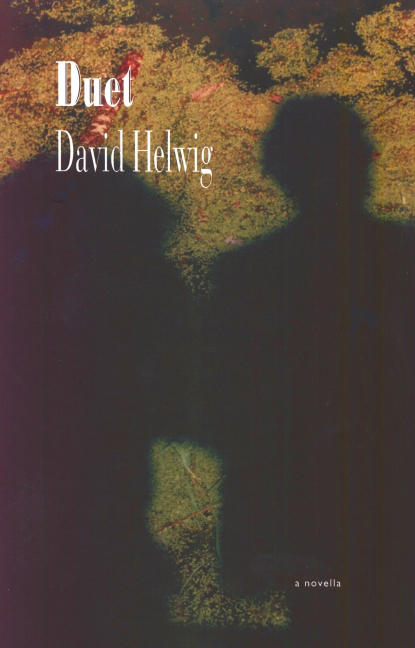
Description
Duet, a vivid and comic account of a stubbornly unromantic romance, is the story of Carman, a retired Toronto policeman, who takes to wandering in the wake of his wife's death. On a whim, he rents a cottage north of Kingston from Norma, the cantankerous proprietor of a rural junk-shop. Sex and death haunt the undergrowth as Carman and Norma grumble and feud, and against the grain of their bad temper begin to create a precarious friendship. Duet is a beautiful novella, but one without prettiness; David Helwig demonstrates a subtle sense of humanity through his creation of two of the prickliest customers in Canadian fiction.
About the author
Born in Toronto in 1938, David Helwig attended the University of Toronto and the University of Liverpool. His first stories were published in Canadian Forum and The Montrealer while he was still an undergraduate. He then went on to teach at Queen's University. He worked in summer stock with the Straw Hat Players, mostly as a business manager and technician, rubbing elbows with such actors as Gordon Pinsent, Jackie Burroughs and Timothy Findley.
While at Queen's University, Helwig did some informal teaching in Collins Bay Penitentiary and subsequently wrote A Book About Billie with a former inmate.
Helwig has also served as literary manager of CBC Television Drama, working under John Hirsch, supervising the work of story editors and the department's relations with writers.
In 1980, he gave up teaching and became a full-time freelance writer. He has done a wide range of writing -- fiction, poetry, essays -- authoring more than twenty books. Helwig is also the founder and long-time editor of the Best Canadian Stories annual. In 2009 he was named as a member of the Order of Canada.
David Helwig lives in the village of Eldon on Prince Edward Island, where he is the third Poet Laureate. He indulges his passion for vocal music by singing with choirs in Montreal, Kingston, and Charlottetown. He has appeared as bass soloist in Handel's Messiah, Bach's St Matthew Passion and Mozart's Requiem.
Excerpt: Duet (by (author) David Helwig)
'Norma was grooming her wolf when the tenant arrived. She had bought a cheap hairbrush from the grocery store and she was brushing the hair of her new stuffed wolf, getting a lot of dust and dirt out of him. The creature was starting to look quite handsome, glass eyes wiped with spit and kleenex and now very bright. She looked toward her tenant, the putative murderer, who was coming toward her. ...'
Editorial Reviews
'Two old curmudgeons -- Carman, a recently widowed, retired police detective with a heart condition, and Norma, a divorced, eccentric, overweight junk collector with painful arthritis -- are the unlikely duea of the title of this novella. Helwig's memorable characters are thrown together by chance when Carman, driving aimlessly around Ontario, happens upon a small town with a cottage to rent. On the surface, the argumentative pair seem to have nothing in common, but the reader soon realizes that they share unsatisfying relationships with their children, a dismay at having lost their spouses and at experiencing the physical limitations of aging, and a general anger at the world that disguises their basic need for human connection. The book is essentially a series of interior monologues by both characters, ruminations on the meaning of existence and nonexistence and the fleeting nature of relationships, interspersed with evocative descriptions of nature and small-town Ontario. There's a certain black humour throughout as the duet of bickering grudgingly evolves into an almost loving relationship by the end of the story.'
Canadian Book Review Annual
'The people Helwig creates in Duet remind us that we've all met someone like them, in a place like this; maybe we even wondered what made them who they are, or appear to be. And although it's a great temptation to want the sparks to keep flying between Norma and Carman, we're glad of the unlikely harmonies found along the way. If there is a downside to this book, it's in the fact that we come to the end and can't help but wish we could remain with these folks a little longer.'
Books in Canada
'Helwig's carefully controlled prose and natural dialogue glow ...'
Edmonton Journal
'Helwig superbly explores complex philosophical ideas. His style is engaging and informing, his sense of dialogue extraordinary.'
Winnipeg Free Press
'Helwig proves himself [...] a storyteller of the first rank and a stylist of simple elegance.'
The Montreal Gazette
'The structure of the book feels familiar -- two damaged old cranks slowly gain mutual respect and forge a shaky bond -- but Helwig makes it work by allowing the relationship to play out at a deliberately slow pace, drawing out the characters on their own terms and rarely forcing conflict upon them. Many of the story's most dramatic moments occur off the page, undercutting the potential melodrama.'
Quill & Quire
'There's a dry humour in this story and a tangy pleasure in the toe-stubbing tango these two dance. But there is far more to Duet than its gentle humour. Helwig is a master at portraying unstated but deeply felt emotions. He knows the power of silence and of small quiet moments. ... In real life, Carman and Norma are both people you'd probably go out of your way to avoid. But here, with David Helwig to tell their story, you'll grow to like them and appreciate their rough edges. His telling is moving and affectionate, flawless in realism and technique.'
Edmonton Journal
'For the past 25 years he has given us a fictional chronicle of ourselves set against our times, without moralizing or grandstanding, but with compassion and honesty.'
Ottawa Citizen


