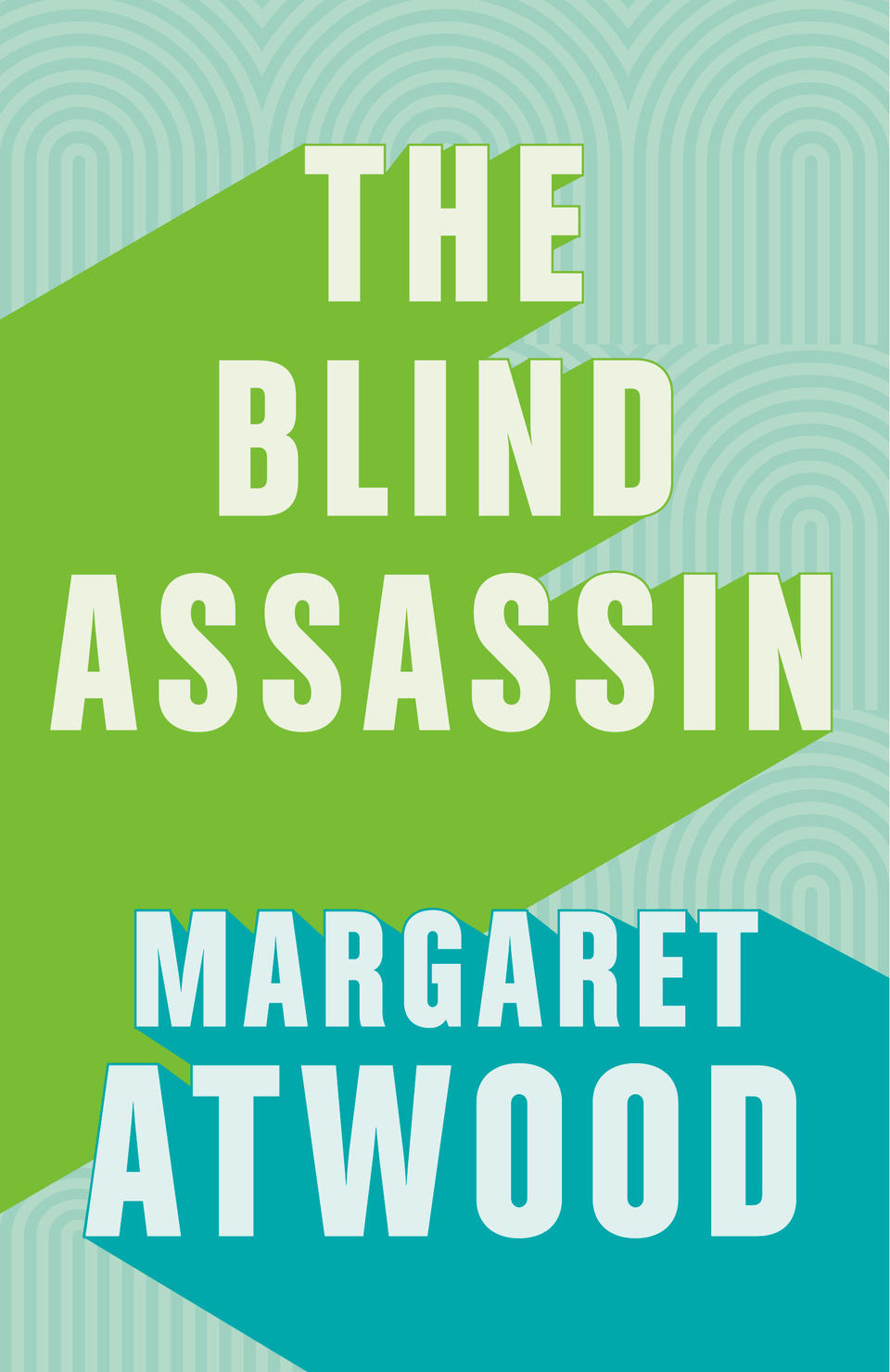
The Blind Assassin
- Publisher
- McClelland & Stewart
- Initial publish date
- Sep 2011
- Category
- General, Historical, Historical
-
Audio disc
- ISBN
- 9780864924018
- Publish Date
- Sep 2005
- List Price
- $29.95
-
Paperback / softback
- ISBN
- 9780771008641
- Publish Date
- Feb 2003
- List Price
- $24.99
-
Paperback / softback
- ISBN
- 9780770428822
- Publish Date
- Sep 2001
- List Price
- $11.99
-
Paperback / softback
- ISBN
- 9780771008917
- Publish Date
- Sep 2011
- List Price
- $23.00
Add it to your shelf
Where to buy it
Description
“Ten days after the war ended, my sister Laura drove a car off a bridge.”
Iris Chase Griffen, married at eighteen to a wealthy industrialist but now poor and eighty-two, recalls her far from exemplary life, and the events leading up to her sister’s death, gradually revealing the carefully guarded Chase family secrets. Among these is a novel that earned the dead Laura Chase not only notoriety but also a devoted cult following. Sexually explicit for its time, The Blind Assassin describes a risky affair in the turbulent thirties between a wealthy young woman and a man on the run. During their secret meetings in rented rooms, the lovers concoct a pulp fantasy set on a distant planet. As the invented story twists through love and sacrifice and betrayal, so does the real one; while events in both move closer to war and catastrophe. By turns lyrical, outrageous, formidable, compelling and funny, this is a novel filled with deep humour and dark drama that comes together in a brilliant and astonishing final twist.
About the author
Margaret Atwood was born in 1939 in Ottawa and grew up in northern Ontario, Quebec, and Toronto. She received her undergraduate degree from Victoria College at the University of Toronto and her master's degree from Radcliffe College.
Throughout her writing career, Margaret Atwood has received numerous awards and honourary degrees. She is the author of more than fifty volumes of poetry, children’s literature, fiction, and non-fiction and is perhaps best known for her novels, which include The Edible Woman (1970), The Handmaid's Tale (1983), The Robber Bride (1994), Alias Grace (1996), and The Blind Assassin, which won the prestigious Booker Prize in 2000. Atwood's dystopic novel, Oryx and Crake, was published in 2003. The Tent (mini-fictions) and Moral Disorder (short stories) both appeared in 2006. Her most recent volume of poetry, The Door, was published in 2007. Her non-fiction book, Payback: Debt and the Shadow Side of Wealth, part of the Massey Lecture series, appeared in 2008, and her most recent novel, The Year of the Flood, in the autumn of 2009. Ms. Atwood's work has been published in more than forty languages, including Farsi, Japanese, Turkish, Finnish, Korean, Icelandic and Estonian. In 2004 she co-invented the Long Pen TM.
Margaret Atwood currently lives in Toronto with writer Graeme Gibson.
Awards
- Winner, Hammett Prize
- Winner, Booker Prize
- Nominated, Orange Prize for Fiction
- Nominated, Governor General's Literary Awards - Fiction
- Nominated, International IMPAC Dublin Literary Award
Excerpt: The Blind Assassin (by (author) Margaret Atwood)
The Bridge
Ten days after the war ended, my sister Laura drove a car off a bridge. The bridge was being repaired: she went right through the Danger sign. The car fell a hundred feet into the ravine, smashing through the treetops feathery with new leaves, then burst into flames and rolled down into the shallow creek at the bottom. Chunks of the bridge fell on top of it. Nothing much was left of her but charred smithereens.
I was informed of the accident by a policeman: the car was mine, and they'd traced the licence. His tone was respectful: no doubt he recognized Richard's name. He said the tires may have caught on a streetcar track or the brakes may have failed, but he also felt bound to inform me that two witnesses—a retired lawyer and a bank teller, dependable people—had claimed to have seen the whole thing. They'd said Laura had turned the car sharply and deliberately, and had plunged off the bridge with no more fuss than stepping off a curb. They'd noticed her hands on the wheel because of the white gloves she'd been wearing.
It wasn't the brakes, I thought. She had her reasons. Not that they were ever the same as anybody else's reasons. She was completely ruthless in that way.
"I suppose you want someone to identify her," I said. "I'll come down as soon as I can." I could hear the calmness of my own voice, as if from a distance. In reality I could barely get the words out; my mouth was numb, my entire face was rigid with pain. I felt as if I'd been to the dentist. I was furious with Laura for what she'd done, but also with the policeman for implying that she'd done it. A hot wind was blowing around my head, the strands of my hair lifting and swirling in it, like ink spilled in water.
"I'm afraid there will be an inquest, Mrs. Griffen," he said.
"Naturally," I said. "But it was an accident. My sister was never a good driver."
I could picture the smooth oval of Laura's face, her neatly pinned chignon, the dress she would have been wearing: a shirtwaist with a small rounded collar, in a sober colour-navy blue or steel grey or hospital-corridor green. Penitential colours—less like something she'd chosen to put on than like something she'd been locked up in. Her solemn half-smile; the amazed lift of her eyebrows, as if she were admiring the view.
The white gloves: a Pontius Pilate gesture. She was washing her hands of me. Of all of us. What had she been thinking of as the car sailed off the bridge, then hung suspended in the afternoon sunlight, glinting like a dragonfly for that one instant of held breath before the plummet? Of Alex, of Richard, of bad faith, of our father and his wreckage; of God, perhaps, and her fatal, triangular bargain. Or of the stack of cheap school exercise books that she must have hidden that very morning, in the bureau drawer where I kept my stockings, knowing I would be the one to find them.
When the policeman had gone I went upstairs to change. To visit the morgue I would need gloves, and a hat with a veil. Something to cover the eyes. There might be reporters. I would have to call a taxi. Also I ought to warn Richard, at his office: he would wish to have a statement of grief prepared. I went into my dressing room: I would need black, and a handkerchief.
I opened the drawer, I saw the notebooks. I undid the crisscross of kitchen string that tied them together. I noticed that my teeth were chattering, and that I was cold all over. I must be in shock, I decided.
What I remembered then was Reenie, from when we were little. It was Reenie who'd done the bandaging, of scrapes and cuts and minor injuries: Mother might be resting, or doing good deeds elsewhere, but Reenie was always there. She'd scoop us up and sit us on the white enamel kitchen table, alongside the pie dough she was rolling out or the chicken she was cutting up or the fish she was gutting, and give us a lump of brown sugar to get us to close our mouths. Tell me where it hurts, she'd say. Stop howling. Just calm down and show me where.
But some people can't tell where it hurts. They can't calm down. They can't ever stop howling.
The Toronto Star, May 26, 1945
Questions Raised at the Death
Special to the Star
A coroner's inquest has returned a verdict of accidental death in last week's St. Clair Ave. fatality. Miss Laura Chase, 25, was travelling west on the afternoon of May 18 when her car swerved through the barriers protecting a repair site on the bridge and crashed into the ravine below, catching fire. Miss Chase was killed instantly. Her sister, Mrs. Richard E. Griffen, wife of the prominent manufacturer, gave evidence that Miss Chase suffered from severe headaches affecting her vision. In reply to questioning, she denied any possibility of intoxication as Miss Chase did not drink.
It was the police view that a tire caught in an exposed streetcar track was a contributing factor. Questions were raised as to the adequacy of safety precautions taken by the City, but after expert testimony by City engineer Gordon Perkins these were dismissed.
The accident has occasioned renewed protests over the state of the streetcar tracks on this stretch of roadway. Mr. Herb T. Jolliffe, representing local ratepayers, told Star reporters that this was not the worst mishap caused by neglected tracks. City Council should take note.
The Blind Assassin. By Laura Chase.
Reingold, Jaynes & Moreau, New York, 1947
Prologue: Perennials for the Rock Garden
She has a single photograph of him. She tucked it into a brown envelope on which she'd written clippings, and hid the envelope between the pages of Perennials for the Rock Garden, where no one else would ever look.
She's preserved this photo carefully, because it's almost all she has left of him. It's black and white, taken by one of those boxy, cumbersome flash cameras from before the war, with their accordion-pleat nozzles and their well-made leather cases that looked like muzzles, with straps and intricate buckles. The photo is of the two of them together, her and this man, on a picnic. Picnic is written on the back, in pencil-not his name or hers, just picnic. She knows the names, she doesn't need to write them down.
They're sitting under a tree; it might have been an apple tree; she didn't notice the tree much at the time. She's wearing a white blouse with the sleeves rolled to the elbow and a wide skirt tucked around her knees. There must have been a breeze, because of the way the shirt is blowing up against her; or perhaps it wasn't blowing, perhaps it was clinging; perhaps it was hot. It was hot. Holding her hand over the picture, she can still feel the heat coming up from it, like the heat from a sun-warmed stone at midnight.
The man is wearing a light-coloured hat, angled down on his head and partially shading his face. His face appears to be more darkly tanned than hers. She's turned half towards him, and smiling, in a way she can't remember smiling at anyone since. She seems very young in the picture, too young, though she hadn't considered herself too young at the time.
Editorial Reviews
"Brilliant. . . . Opulent. . . . Atwood is a poet . . . as well as a contriver of fiction, and scarcely a sentence of her quick, dry yet avid prose fails to do useful work, adding to a picture that becomes enormous." —John Updike, The New Yorker
"The kind of story so full of intrigue and desperation that you take it to bed with you simply because you can't bear to put it down. . . . It's one thing to write an accomplished novel; it's another entirely to spin a tale so brilliantly that the reader internalizes it." —Harper's Bazaar
"Absorbing. . . . Expertly rendered. . . . Virtuosic storytelling is on display." —New York Times
Other titles by

El cuento de la criada, / The Handmaid's Tale

El asesino ciego / The Blind Assassin

Farley and Claire
A Love Story

Cuestiones candentes: Una mirada crítica a la realidad actual, desde el feminism o hasta el cambio climático / Burning Questions

Old Babes in the Wood
Stories

Ojo de Gato / Cats Eye

Dearly
Poems

This Time, That Place
Selected Stories

We Are Still Here
Afghan Women on Courage, Freedom, and the Fight to Be Heard

Burning Questions (Signed Edition)
Essays and Occasional Pieces, 2004-2021


