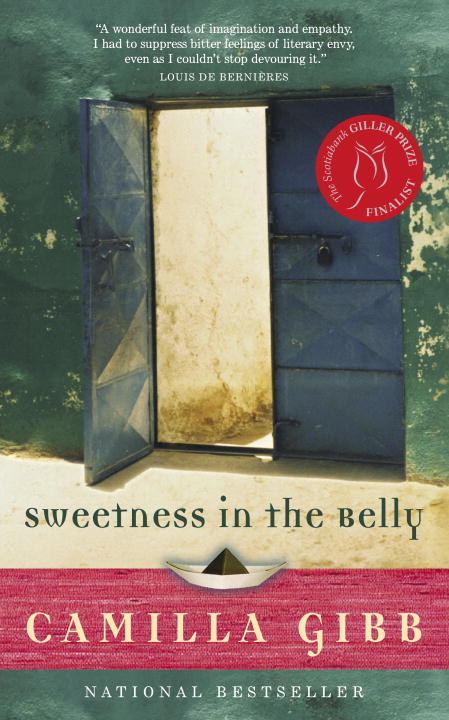
Sweetness in the Belly
- Publisher
- Doubleday Canada
- Initial publish date
- Feb 2006
- Category
- Literary, Contemporary Women, Coming of Age
-
Paperback / softback
- ISBN
- 9780385660181
- Publish Date
- Feb 2006
- List Price
- $21.00
Add it to your shelf
Where to buy it
Description
NOW A MAJOR MOTION PICTURE
Set in Emperor Haile Selassie’s Ethiopia and the racially charged world of Thatcher’s London, Sweetness in the Belly is a richly detailed portrayal of one woman’s search for love and belonging. Lilly, born to British parents, eventually finds herself living as a devout, young, white Muslim woman in the ancient walled city of Harar in the years leading up to the deposition of the emperor. She is drawn to an idealistic young doctor, Aziz, but their love has only just begun to fulfil its promise when the convulsions of a new order wrench them apart, sending Lilly to an England she has never seen, and Aziz into the darkness of a radical revolution. Camilla Gibb brings to life characters facing extraordinary hardship and loss with the unblinking honesty and emotional generosity that have made her one of Canada’s most exciting literary talents.
About the author
Awards
- Nominated, IMPAC Dublin Literary Award
- Winner, Trillium Book Award
- Nominated, Scotiabank Giller Prize
Contributor Notes
CAMILLA GIBB was born in London, England, and grew up in Toronto. She is the author of five internationally acclaimed novels—Mouthing the Words, The Petty Details of So-and-so's Life, Sweetness in the Belly, The Beauty of Humanity Movement and The Relative—as well as the bestselling memoir This is Happy. Camilla has been the recipient of the Trillium Book Award, the City of Toronto Book Award and the CBC Canadian Literary Award and has been shortlisted for the RBC Taylor Prize and the Scotiabank Giller Prize. She has a Ph.D. from Oxford University and is an adjunct faculty member of the graduate creative writing programs at the University of Toronto and the University of Guelph.
Visit her at www.camillagibb.com
Excerpt: Sweetness in the Belly (by (author) Camilla Gibb)
Prologue
Harar, Ethiopia
The sun makes its orange way east from Arabia, over a Red Sea, across volcanic fields and desert and over the black hills to the qat- and coffee-shrubbed land of the fertile valley that surrounds our walled city. Night departs on the heels of the hyenas: they hear the sun’s approach as a hostile ringing, perceptible only to their ears, and it drives them back, bloody lipped and panic stricken, to their caves.
In darkness they have feasted on the city’s broken streets: devouring lame dogs in alleyways and licking eggshells and entrails off the ground. The people of the city cannot afford to waste their food, but nor can they neglect to feed the hyenas either. To let them go hungry is to forfeit their role as people on this wild earth, and strain the already tenuous ties that bind God’s creatures.
A hundred years ago, when the city’s gates were still closed at night — the key lodged firmly under the sleeping head of a neurotic emir — the hyenas were the only outsiders permitted access after dark. They would crawl through the drainage portals in the city’s clay walls. But the gates are splayed open now, have been for decades, a symbol of history’s turn against this Muslim outpost, a city of saints and scholars founded by Arabs who brought Islam to Abyssinia in the ninth century, the former capital of an emirate that once ruled for hundreds of miles.
For all the fear they inspire, though, if a hyena must die, one hopes it might do so on one’s doorstep. Pluck its eyebrows, fashion a bracelet, and you are guaranteed protection from buda, the evil eye. Endure the inconvenience of having to step over a hideous corpse baking in the African sun all day, but be assured that by the following morning, thanks to hyenas’ lack of inhibitions regarding cannibalism, the street will once again be licked clean.
As every day begins, the anguished cries of these feral children grow dim against a rising crescendo of birds quibbling in the pomegranate and lime trees of the city’s courtyards. And then the muezzins call: beckoning the city’s sleeping populace with a shower of praise for an almighty God. There are ninety-nine of them within the walls of this tiny city — ninety-nine muezzins for ninety-nine mosques. It takes the culmination of the staggered, near-simultaneous beginnings of a hundred less one to create the particular sound that is heard as Godliness in Harar.
* * * * * * *
“But I don’t want to go among mad people,” Alice remarked.
“Oh, you ca’n’t help that,” said the Cat: “we’re all mad here. I’m mad. You’re mad.”
“How do you know I’m mad?” said Alice.
“You must be,” said the Cat, “or you wouldn’t have come here.”
—Alice’s Adventures in Wonderland, Lewis Carroll
Part One
London, England
1981–85
Scar Tissue
On a wet night in Thatcher’s Britain, a miracle was delivered onto the pockmarked pavement behind a decrepit building once known as Lambeth Hospital. Four women standing flanked by battered rubbish bins looked up to a close English sky and thanked Allah for this sign of his generosity. Two women ululated, one little boy, shy and tired, buried his face in his mother’s neck, and one baby stamped with a continent-shaped mole tried out her lungs. Her wail was mighty and unselfconscious, and with it, she announced that we had all arrived in England. None of us had hitherto had the confidence to be so brazen.
I was one of those four women. I trained in this God-forsaken building, a gothic nightmare of a place, a former workhouse where the poor were imprisoned and divided — men from women, aged and infirm from able bodied, able-bodied good from able-bodied bad — each forced to break a daily quota of stone in order to earn their keep. Adjacent is the old infirmary, which once had its own Register of Lunatics, among them a woman named Hannah Chaplin diagnosed with acute psychosis resulting from syphilis while in residence there with her seven-year-old son Charlie, some eighty years ago.
I don’t share this history though I’ve moved within its walls. In the places I have lived, the aged and the infirm and the psychotic are not separated from the rest of us. They are part of us. I don’t share this history, but as a child, I did see a Charlie Chaplin film in a cinema in Tangier through the smoke of a hundred cigarettes. I sat cross-legged between my parents on a wooden bench, a carpet of peanut shells at our feet, the audience roaring with laughter, united by the shared language of bodies without words.
Amazing that humour could ever be borne of this place. The building now stands condemned, slated for demolition, and I work at South Western, a hospital largely catering to the poor from the beleaguered housing estates in the surrounding areas: the mentally ill, the drug addicted, the unemployed white, the Asian and Afro-Caribbean immigrants and the refugees and asylum seekers, the latest wave of which has been rolling in from torn parts of East Africa, principally Eritrea and Sudan.
Many of these claimants avoid the hospital, overwhelmed or intimidated as they are by the agents and agencies of the state — the customs officers, police, civil servants, lawyers, social workers and doctors — with their unreadable expressions and their unreadable forms. I know this, because they are my neighbours. I encounter them in the elevator, in the laundrette, in the dimly lit concrete corridors of high-rises on the Cotton Gardens Estate. I’ve lived in a one-bedroom council flat on the fourteenth floor of one of these buildings since the autumn of 1974 — compensation for the circumstances of my arrival.
My white face and white uniform give me the appearance of authority in this new world, though my experiences, as my neighbours quickly come to discover, are rooted in the old. I’m a white Muslim woman raised in Africa, now employed by the National Health Service. I exist somewhere between what they know and what they fear, somewhere between the past and the future, which is not quite the present. I can translate the forms for them before kneeling down and putting my forehead to the same ground. Linoleum, concrete, industrial carpet. Five times a day, wherever we might be, however much we might doubt ourselves and the world around us.
I was not always a Muslim, but once I was led into the absorption of prayer and the mysteries of the Qur’an, something troubled in me became still.
Editorial Reviews
One of Amazon.ca's Best Books of 2005
National Bestseller
Winner of the Trillium Book Award
A Scotiabank Giller Prize Finalist
A Globe and Mail Top 100 Book of 2005
“Sweetness in the Belly is a timely and compelling novel of ideas which explores the ethics of cultural identity in a multicultural era. . . . [It] is a sophisticated, ambitious and deeply affecting novel which is devastatingly relevant to our contemporary world.”
–2005 Scotiabank Giller Prize jury citation
“Gibb’s Africa is finely crafted, as is her delicate rendering of the complexities of Ethiopian society. . . . The book rings true.”
—Time Magazine
“This complex tale about exile, romance and human rights combines the authority of Gibb’s scholarship on social anthropology with the lushness of her fictional vision.”
—Elle Canada
“Ambitious . . . vivid and rich in detail, politically relevant and eminently readable.”
—The Globe and Mail
“This is a rarity, a novel that transforms expectations. A hugely ambitious work executed with deceptive ease, it is an unbelievably odd tale, yet utterly convincing, able to transport us behind closed borders and back again. . . . The back-and-forth structure succeeds brilliantly . . . With Sweetness in the Belly, you know something other than lived experience is at work, and that something is a roving mind, a questing heart. Watching them land like butterflies on raw truth is a marvellous sight to behold.”
—The Gazette (Montreal)
“A marvellous, highly absorbing read bound to strike up conversations at award time.”
—Ottawa Citizen
“Full of life and keen observation of women and how they rise above the terrible things that can happen to them, how they form communities, how they find strength to begin again. This may be Lilly’s story, but behind her stands the larger story of her Muslim friends. They are what make the novel so extraordinary, so rich.”
—National Post
“Camilla Gibb’s integration of history and fiction in Sweetness and the Belly is superb. . . . Gibb’s crowning achievement is a knack for creating believable historical characters. Characters whose credibility is anchored by the convincing commonplace of their lives.”
—Winnipeg Free Press
“A wonderful feat of imagination and empathy. I had to suppress bitter feelings of literary envy, even as I couldn't stop devouring it.”
—Louis de Bernières
“Sweetness in the Belly is a deeply imagined immersion into the lives of people for whom war, poverty, marginalization and exile are the commonplace trials. Gibb’ s understanding of this world seems almost uncanny but it is her compassion for her characters that impressed me the most. Here is a novel that challenges and disturbs as it enlightens and uplifts. A really exceptional achievement.”
—Barbara Gowdy
“With Sweetness in the Belly, Camilla Gibb offers persuasive testimony about her ambition as a novelist. . . . This novel is impressive for its geographic and thematic broadness alone. Gibb makes it that much more remarkable with the careful attention she gives to the psychology of belonging.”
—The Vancouver Sun
Other titles by


Related lists
 5 books
Author Spotlight: Camilla Gibb
 14 books
Amazing Food Scenes in CanLit
 16 books
Intrepid Travellers: Canadian Women in the World
 22 books
Visceral: Shivers & Thrills
 34 books
Top 40: CBC Canada Reads 2014
 18 books
All-Time Favourites
 20 books
My List
 6 books
