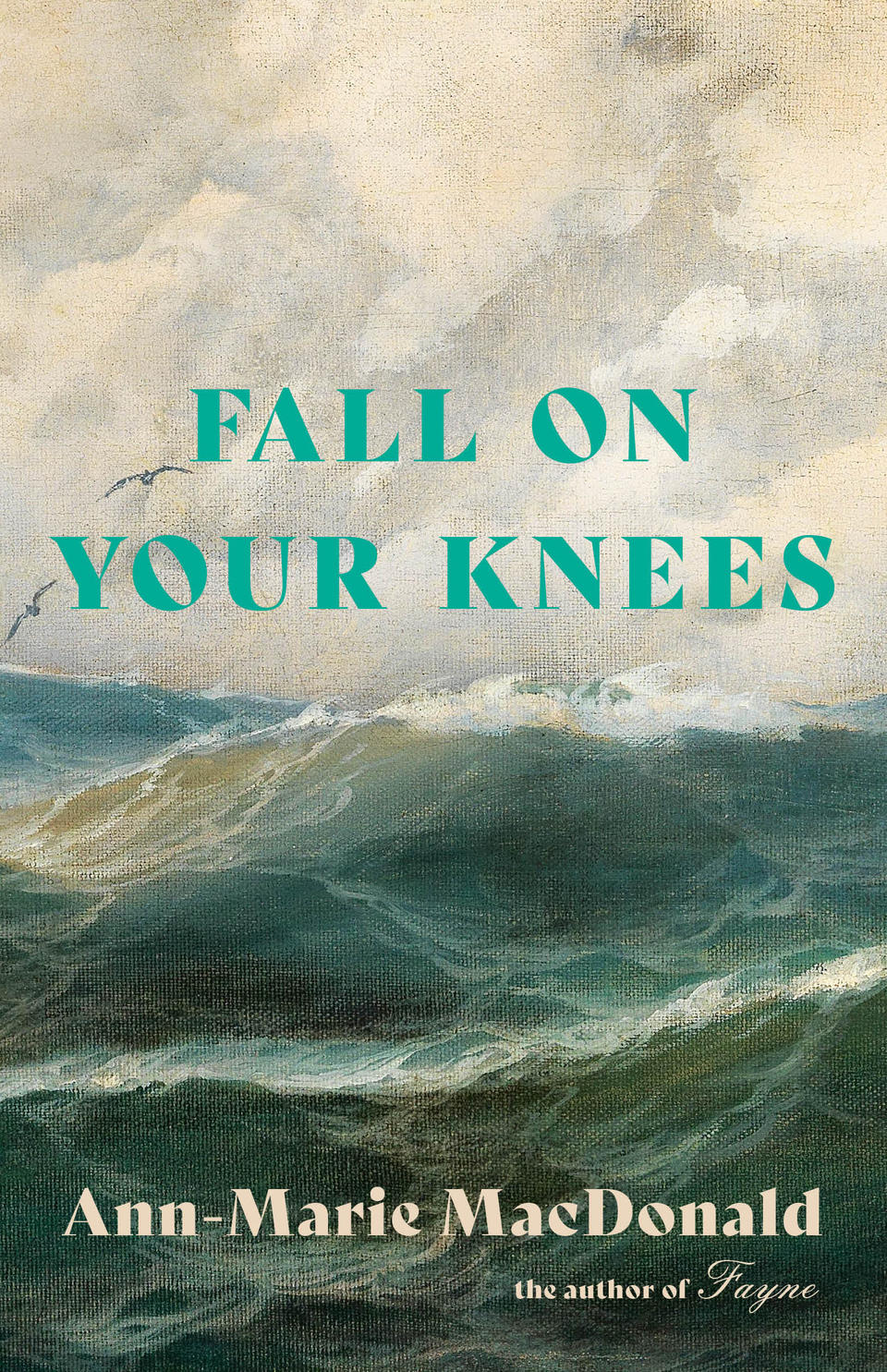
Fall on Your Knees
- Publisher
- Knopf Canada
- Initial publish date
- Aug 1997
- Category
- Family Life, Historical, Literary
-
Paperback / softback
- ISBN
- 9780394281780
- Publish Date
- Aug 1997
- List Price
- $24.95
Add it to your shelf
Where to buy it
Description
Winner of the Commonwealth Writers' Prize for Best Book
Following the curves of history in the first half of the twentieth century, Fall On Your Knees takes us from haunted Cape Breton Island, Nova Scotia, through the battle fields of World War One, to the emerging jazz scene of New York City and into the lives of four unforgettable sisters. The mythically charged Piper family—James, a father of intelligence and immense ambition, Materia, his Lebanese child-bride, and their daughters: Kathleen, a budding opera Diva; Frances, the incorrigible liar and hell-bent bad girl; Mercedes, obsessive Catholic and protector of the flock; and Lily, the adored invalid who takes us on a quest for truth and redemption—is supported by a richly textured cast of characters. Together they weave a tale of inescapable family bonds, of terrible secrets, of miracles, racial strife, attempted murder, birth and death, and forbidden love. Moving and finely written, Fall On Your Knees is by turns dark and hilariously funny, a story—and a world—that resonate long after the last page is turned.
About the author
Ann-Marie MacDonald is an award-winning novelist, playwright, actor, and broadcast host. Her writing for the stage includes the plays Goodnight Desdemona (Good Morning Juliet), Belle Moral: A Natural History, and Hamlet-911, along with the libretto for the chamber opera Nigredo Hotel, and book and lyrics for the musical Anything That Moves. She is the author of the bestselling novels Fall On Your Knees, The Way the Crow Flies, and Adult Onset. Ann-Marie is a graduate of the acting program of the National Theatre School of Canada. In 2018 she was made an Officer of the Order of Canada in recognition of her contribution to the arts and her LGBTQ2SI+ activism. She is married to theatre director Alisa Palmer, with whom she has two children.
Awards
- Winner, Canadian Booksellers Association Libris Award - Fiction Book of the Year
- Winner, Commonwealth Writers Prize for Best First Book
- Short-listed, Scotiabank Giller Prize
- Winner, Canadian Authors Association Literary Award
- Winner, Dartmouth Book Award for Fiction
Excerpt: Fall on Your Knees (by (author) Ann-Marie MacDonald)
Silent Pictures
They're all dead now.
Here's a picture of the town where they lived. New Waterford. It's a night bright with the moon. Imagine you are looking down from the height of a church steeple, onto the vivid gradations of light and shadow that make the picture. A small mining town near cutaway cliffs that curve over narrow rock beaches below, where the silver sea rolls and rolls, flattering the moon. Not many trees, thin grass. The silhouette of a colliery, iron tower against a slim pewter sky with cables and supports sloping at forty-five-degree angles to the ground. Railway tracks that stretch only a short distance from the base of a gorgeous high slant of glinting coal, towards an archway in the earth where the tracks slope in and down and disappear. And spreading away from the collieries and coal heaps are the peaked roofs of the miners' houses built row on row by the coal company. Company houses. Company town.
Look down over the street where they lived. Water Street. An avenue of packed dust and scattered stones that leads out past the edge of town to where the wide, keeling graveyard overlooks the ocean. That sighing sound is just the sea.
Here's a picture of their house as it was then. White, wood frame with the covered veranda. It's big compared to the miners' houses. There's a piano in the front room. In the back is the kitchen where Mumma died.
Here's a picture of her the day she died. She had a stroke while cleaning the oven. Which is how the doctor put it. Of course you can't see her face for the oven, but you can see where she had her stockings rolled down for housework and, although this is a black and white picture, her house-dress actually is black since she was in mourning for Kathleen at the time, as well as Ambrose. You can't tell from this picture, but Mumma couldn't speak English very well. Mercedes found her like that, half in half out of the oven like the witch in Hansel and Gretel. What did she plan to cook that day? When Mumma died, all the eggs in the pantry went bad - they must have because you could smell that sulphur smell all the way down Water Street.
So that's the house at 191 Water Street, New Waterford, Cape Breton Island, in the far eastern province of Nova Scotia, Canada. And that's Ma on the day she died, June 23, 1919.
Here's a picture of Daddy. He's not dead, he's asleep. You see that armchair he's in? That's the pale green wingback. His hair is braided. That's not an ethnic custom. They were only ethnic on Mumma's side. Those are braids that Lily put in his hair while he was asleep.
There are no pictures of Ambrose, there wasn't time for that. Here's a picture of his crib still warm.
Other Lily is in limbo. She lived a day, then died before she could be baptized, and went straight to limbo along with all the other unbaptized babies and the good heathens. They don't suffer, they just sort of hang there effortlessly and unaware. Jesus is known to have gone into limbo occasionally and taken a particularly good heathen out of it and up to heaven. So it is possible. Otherwise....That's why this picture of Other Lily is a white blank.
Don't worry. Ambrose was baptized.
Here's one of Mercedes. That opal rosary of hers was basically priceless. An opal rosary, can you imagine? She kept it pinned to the inside of her brassiere, over her heart, at all times when she wasn't using it. Partly for divine protection, partly out of the convenience of never being without the means to say a quick decade of the beads when the spirit moved her, which was often. Although, as Mercedes liked to point out, you can say the rosary with any objects at hand if you find yourself in need of a prayer but without your beads. For example, you can say it with pebbles or breadcrumbs. Frances wanted to know, could you say the rosary with cigarette butts? The answer was yes, if you're pure at heart. With mouse turds? With someone's freckles? The dots in a newspaper photograph of Harry Houdini? That's enough, Frances. In any case, this is a picture of Mercedes, holding her opal rosary, with one finger raised and pressed against her lips. She's saying, "Shshsh."
And this is Frances. But wait, she's not in it yet. This one is a moving picture. It was taken at night, behind the house. There's the creek, flowing black and shiny between its narrow banks. And there's the garden on the other side. Imagine you can hear the creek trickling. Like a girl telling a secret in a language so much like our own. A still night, a midnight clear. It's only fair to tell you that a neighbour once saw the dismembered image of his son in this creek, only to learn upon his arrival home for supper that his son had been crushed to death by a fall of stone in Number 12 Mine.
But tonight the surface of the creek is merely as Nature made it. And certainly it's odd but not at all supernatural to see the surface break, and a real live soaked and shivering girl rise up from the water and stare straight at us. Or at someone just behind us. Frances. What's she doing in the middle of the creek, in the middle of the night? And what's she hugging to her chest with her chicken-skinny arms? A dark wet bundle. Did it stir just now? What are you doing, Frances?
But even if she were to answer, we wouldn't know what she was saying, because, although this is a moving picture, it is also a silent one.
All the pictures of Kathleen were destroyed. All except one. And it's been put away.
Kathleen sang so beautifully that God wanted her to sing for Him in heaven with His choir of angels. So He took her.
Editorial Reviews
#1 National Bestseller
Winner of the Commonwealth Writers' Prize for Best First Book
Oprah's Book of the Month Club Pick, January 2002
Winner of the Dartmouth Book Award
Winner of the Canadian Authors' Association Award
Winner of the CBA Libris People's Choice Award
Winner of the CBA Libris Award for Fiction Book of the Year
Finals for The International IMPAC Dublin Literary Award
Finalist for the Giller Prize
Finalist for the Chapters/Books in Canada First Novel Award
Finalist for the Trillium Book Award
Finalist for The Orange Prize for Fiction
"Magnetic. . . a dizzying leap into a mind so rich and complex you spend almost as much time marvelling how she got there as enjoying the results. . . . Compelling and original. . . MacDonald succeeds brilliantly in building a world that, at least for the satisfying length of time it takes to finish Fall On Your Knees, gloriously supersedes all else." —Financial Post
"Beautiful . . . this big, bold, epic shocker of a novel reads as if John Irving met Joyce Carol Oates. It is history told with a thumping, complex narrative . . . a host of colourful characters and a great big bow to psychology. . . . Fall On Your Knees is the work of a big talent. It's a wild ride." —Chicago Tribune
"[MacDonald is] a first-rate novelist. . . . [She] paints a Cape Breton landscape steeped in human emotion . . . She has found the language of the heart that runs below everyday discourse. . . . There is no resisting this story." —The Globe and Mail
"Ann-Marie MacDonald—one of Canada's most talented actors and playwrights—has provided us with yet another aspect of a talent that has no limits." —Timothy Findley
"Brilliant. . . Profoundly and refreshingly different. . . . MacDonald has constructed a plot worthy of Victor Hugo. . . A standout." —Vancouver Sun
"MacDonald is a master of exciting story-telling, of suspense and surprise." —The Montreal Gazette
". . . a narrative presence that can look at the unbearable, and sustain the emotion of it, and deliver it up edged in mordant wit."
—EDITOR'S CHOICE, Notable Books of 1996, The Globe and Mail
". . . a multi-generational saga . . . carried off with great assurance and style."
—Philip Marchand, CRITIC'S CHOICE, The Toronto Star
". . . utterly compelling—a brilliant take on the black themes of racism, physical and emotional battery, sexual abuse, suicide, and murder."
—The Vancouver Review
"Stunning. . .The book and the talent behind it are big. The story is riveting, the characters achingly human, and the writing will take your breath away. . .[MacDonald] has leapt into the first rank of fiction writers."
—Toronto Star
"A delicious story, one of those sweeping family sagas to take on summer vacation and savor. . . . MacDonald is a master of exciting story-telling, of suspense and surprise. She has a dramatic touch that can elicit gasps from readers."
—Montreal Gazette
"Not a single line is superfluous in this richly layered tale of the secrets within several generations of a Canadian family."
—Publisher's Weekly starred review February 24th, 1997
"Here is an explosive mix of family feuds and incest, musical dreams and melodrama, all shot through with a fierce guilt. . . Fall On Your Knees is a heady, haunting brew, carefully structured, witty and distinctive."
—The London Observer
"Some wonderful writing has come out of Canada in recent years from such authors as Robertson Davies and Margaret Atwood. Now they are joined by the multi-talented Ann-Marie MacDonald. . . She is already a successful actress & playwright. It seems almost unfair that she should have written a brilliant first novel."
—Sunday Telegraph
Other titles by


Related lists


Related blog posts

The Keepers on My Bookshelf
Depth and humour are themes in this great recommended reading list by the author of the new middle grade novel What's in It for Me?

From the Page to the Screen
A recommended reading list by award-winning filmmaker and author of the novel Claremont.

Christine Higdon: Books That Take You on a Journey
The author of The Very Marrow Of Our Bones offers a spectacular list of recommended reads.

Andrea McPherson: Bad Mothers and Wives
Women who dare to defy society's expectations for them—for better or for worse.